Research theme

Distribution Shift and Monitoring

Methods for recognizing inputs and operating conditions beyond those under which a model can be expected to perform reliably.

Machine-learning models are usually developed under an implicit assumption: future inputs will resemble the data used for training and evaluation. When operating conditions change, that assumption can fail while a model continues to produce confident predictions.

My work in this area studies out-of-distribution and anomaly detection as forms of model monitoring. It includes representation-learning methods, outlier exposure, and detectors augmented with knowledge about the structure of the expected data. Across these approaches, the objective is to produce useful evidence that a learned model may be operating beyond its competence.

Related work

Publications

9 publications
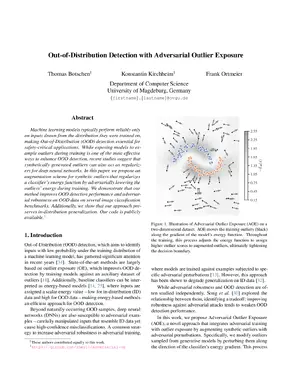
Out-of-Distribution Detection with Adversarial Outlier Exposure (06 Jun. 2025)
Our paper Out-of-Distribution Detection with Adversarial Outlier Exposure has been accepted at the CVPR workshop for Safe Artificial Intelligence for All Domains (SAIAD). The experiments in the paper were mostly conducted by Thomas Botschen, who is currently a master’s …
Categories: Anomaly Detection
Tagged with: CVPR · Generative Models · Anomaly Detection
Thumbnail for Out-of-Distribution Detection with Adversarial Outlier Exposure
Improving Out-of-Distribution Detection with Markov Logic Networks (06 Jun. 2025)
Our paper Improving Out-of-Distribution Detection with Markov Logic Networks has been accepted at ICML. In it, we propose a probabilistic extension of Out-of-Distribution Detection with Logical Reasoning, as well as a simple algorithm to mine logical constraints for OOD detection …
Categories: Neuro-Symbolic
Tagged with: ICML · Neuro-Symbolic · Anomaly Detection
Thumbnail for Improving Out-of-Distribution Detection with Markov Logic Networks
Language Models as Reasoners for Out-of-Distribution Detection (17 Sep. 2024)
Our paper, Language Models as Reasoners for Out-of-Distribution Detection, was presented at the Workshop on AI Safety Engineering (WAISE) 2024 and received the best paper award by popular vote. It constitutes an extension of our idea of Out-of-Distribution Detection with Logical …
Categories: Anomaly Detection Neuro-Symbolic
Tagged with: SafeComp · Anomaly Detection · LLM · Neuro-Symbolic
Thumbnail for Language Models as Reasoners for Out-of-Distribution Detection
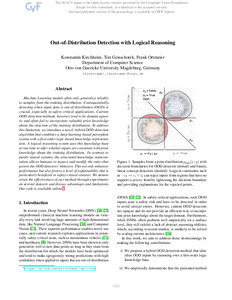
Out-of-Distribution Detection with Logical Reasoning (04 Jan. 2024)
Our paper Out-of-Distribution Detection with Logical Reasoning has been accepted at WACV 2024. Abstract § Machine Learning models often only generalize reliably to samples from the training distribution. Consequentially, detecting when input data is out-of-distribution (OOD) is …
Categories: Anomaly Detection Neuro-Symbolic
Tagged with: WACV · Anomaly Detection · Neuro-Symbolic
Thumbnail for Out-of-Distribution Detection with Logical Reasoning
Towards Deep Anomaly Detection with Structured Knowledge Representations (15 Jun. 2023)
My paper Towards Deep Anomaly Detection with Structured Knowledge Representations has been accepted at the Workshop on AI Safety Engineering at SafeComp. Abstract § Machine learning models tend to only make reliable predictions for inputs that are similar to the training data. …
Categories: Anomaly Detection Neuro-Symbolic
Tagged with: SafeComp · Anomaly Detection · Neuro-Symbolic
Thumbnail for Towards Deep Anomaly Detection with Structured Knowledge Representations
On Outlier Exposure with Generative Models (23 Nov. 2022)
Our paper On Outlier Exposure with Generative Models has been accepted at the NeurIPS Machine Learning Safety Workshop. Abstract § While Outlier Exposure reliably increases the performance of Out-of-Distribution detectors, it requires a set of available outliers during training. …
Categories: Anomaly Detection
Tagged with: NeurIPS · Generative Models · Anomaly Detection
Thumbnail for On Outlier Exposure with Generative Models
Multi-Class Hypersphere Anomaly Detection (MCHAD) (13 Jul. 2022)
Our paper Multi-Class Hypersphere Anomaly Detection (MCHAD) has been accepted for presentation at the ICPR 2022. In summary, we propose a new loss function for learning neural networks that are able to detect anomalies in their inputs. Poster for MCHAD (PDF). MCHAD is available …
Categories: Anomaly Detection
Tagged with: ICPR · Anomaly Detection
Thumbnail for Multi-Class Hypersphere Anomaly Detection (MCHAD)
PyTorch-OOD: A library for Out-of-Distribution Detection based on PyTorch (13 Jul. 2022)
Our paper, PyTorch-OOD: A library for Out-of-Distribution Detection based on PyTorch, has been presented at the CVPR 2022 Workshops. You can find the most recent version of the Python source code on GitHub. The library has developed substantially since the original 2022 paper. …
Categories: Anomaly Detection
Tagged with: CVPR · Anomaly Detection
Thumbnail for PyTorch-OOD: A library for Out-of-Distribution Detection based on PyTorch
Explanation-based Anomaly Detection in Deep Neural Networks (01 Feb. 2020)
Masters Thesis (PDF). If an AI gives you a weird explanation for its prediction, you should remain skeptical about the accuracy of the prediction. Sounds reasonable? This was the general idea of my masters thesis, which was originally titled Self-Assessment of Visual Recognition …
Categories: Anomaly Detection
Tagged with: Deep Learning · Anomaly Detection · CNN · Explainability
Thumbnail for Explanation-based Anomaly Detection in Deep Neural Networks

← Complete publication list