Anomaly Detection

blog/Deutschlandfunk-Interview: Sicherer KI-Einsatz im Bahnbetrieb (13 Dec. 2025)
In December 2025, I spoke with Manfred Kloiber on Deutschlandfunk’s Computer und Kommunikation about the safe use of artificial intelligence in railway operations. The discussion covered the conditions under which machine-learning systems can be deployed in safety-critical railway applications, including the challenge of distribution shift, the need for reliable uncertainty quantification, and how learned components interact with established railway safety processes. The interview is in …
Categories: Machine Learning
87 Words, Tagged with: Anomaly Detection · Autonomous Vehicles

Thumbnail for Deutschlandfunk-Interview: Sicherer KI-Einsatz im Bahnbetrieb
papers/Improving Out-of-Distribution Detection with Markov Logic Networks (06 Jun. 2025)
Our paper Improving Out-of-Distribution Detection with Markov Logic Networks has been accepted at ICML. In it, we propose a probabilistic extension of Out-of-Distribution Detection with Logical Reasoning, as well as a simple algorithm to mine logical constraints for OOD detection from a dataset. Abstract § Out-of-distribution (OOD) detection is essential for ensuring the reliability of deep learning models operating in open-world scenarios. Current OOD detectors mainly rely on statistical models …
Categories: Neuro-Symbolic
173 Words, Tagged with: ICML · Neuro-Symbolic · Anomaly Detection
Thumbnail for Improving Out-of-Distribution Detection with Markov Logic Networks
papers/Out-of-Distribution Detection with Adversarial Outlier Exposure (06 Jun. 2025)
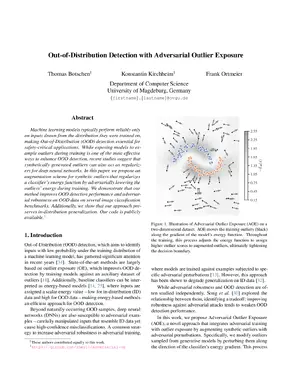
Our paper Out-of-Distribution Detection with Adversarial Outlier Exposure has been accepted at the CVPR workshop for Safe Artificial Intelligence for All Domains (SAIAD). The experiments in the paper were mostly conducted by Thomas Botschen, who is currently a master’s student at our lab. Abstract § Machine learning models typically perform reliably only on inputs drawn from the distribution they were trained on, making Out-of-Distribution (OOD) detection essential for safety-critical …
Categories: Anomaly Detection
163 Words, Tagged with: CVPR · Generative Models · Anomaly Detection
Thumbnail for Out-of-Distribution Detection with Adversarial Outlier Exposure
papers/Language Models as Reasoners for Out-of-Distribution Detection (17 Sep. 2024)
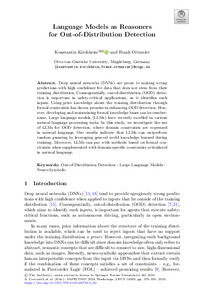
Our paper, Language Models as Reasoners for Out-of-Distribution Detection, was presented at the Workshop on AI Safety Engineering (WAISE) 2024 and received the best paper award by popular vote. It constitutes an extension of our idea of Out-of-Distribution Detection with Logical Reasoning, where we replaced the prolog-based reasoning component with an LLM. Abstract § Deep neural networks (DNNs) are prone to making wrong predictions with high confidence for data that does not stem from their …
Categories: Anomaly Detection · Neuro-Symbolic
195 Words, Tagged with: SafeComp · Anomaly Detection · LLM · Neuro-Symbolic
Thumbnail for Language Models as Reasoners for Out-of-Distribution Detection
papers/Out-of-Distribution Detection with Logical Reasoning (04 Jan. 2024)
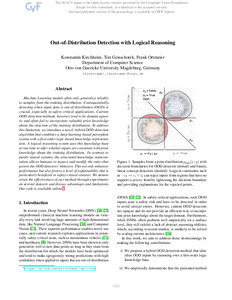
Our paper Out-of-Distribution Detection with Logical Reasoning has been accepted at WACV 2024. Abstract § Machine Learning models often only generalize reliably to samples from the training distribution. Consequentially, detecting when input data is out-of-distribution (OOD) is crucial, especially in safety-critical applications. Current OOD detection methods, however, tend to be domain agnostic and often fail to incorporate valuable prior knowledge about the structure of the training …
Categories: Anomaly Detection · Neuro-Symbolic
225 Words, Tagged with: WACV · Anomaly Detection · Neuro-Symbolic
Thumbnail for Out-of-Distribution Detection with Logical Reasoning
papers/Towards Deep Anomaly Detection with Structured Knowledge Representations (15 Jun. 2023)
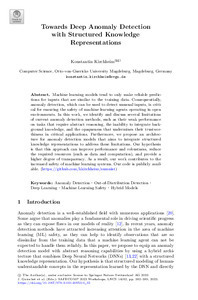
My paper Towards Deep Anomaly Detection with Structured Knowledge Representations has been accepted at the Workshop on AI Safety Engineering at SafeComp. Abstract § Machine learning models tend to only make reliable predictions for inputs that are similar to the training data. Consequentially, anomaly detection, which can be used to detect unusual inputs, is critical for ensuring the safety of machine learning agents operating in open environments. In this work, we identify and discuss several …
Categories: Anomaly Detection · Neuro-Symbolic
181 Words, Tagged with: SafeComp · Anomaly Detection · Neuro-Symbolic
Thumbnail for Towards Deep Anomaly Detection with Structured Knowledge Representations
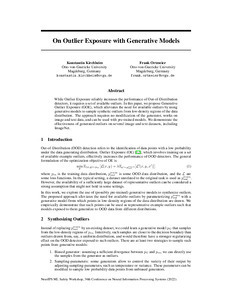
papers/On Outlier Exposure with Generative Models (23 Nov. 2022)
Our paper On Outlier Exposure with Generative Models has been accepted at the NeurIPS Machine Learning Safety Workshop. Abstract § While Outlier Exposure reliably increases the performance of Out-of-Distribution detectors, it requires a set of available outliers during training. In this paper, we propose Generative Outlier Exposure (GOE), which alleviates the need for available outliers by using generative models to sample synthetic outliers from low-density regions of the data distribution. The …
Categories: Anomaly Detection
114 Words, Tagged with: NeurIPS · Generative Models · Anomaly Detection
Thumbnail for On Outlier Exposure with Generative Models
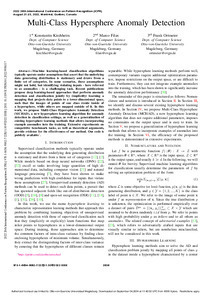
papers/Multi-Class Hypersphere Anomaly Detection (MCHAD) (13 Jul. 2022)
Our paper Multi-Class Hypersphere Anomaly Detection (MCHAD) has been accepted for presentation at the ICPR 2022. In summary, we propose a new loss function for learning neural networks that are able to detect anomalies in their inputs. Poster for MCHAD (PDF). MCHAD is available via pytorch-ood. You can find example code here. How does it work? § The general idea is that we want a neural network $f_{\theta}: \mathcal{X} \rightarrow \mathcal{Z}$ that maps inputs from the input space to some lower …
Categories: Anomaly Detection
586 Words, Tagged with: ICPR · Anomaly Detection
Thumbnail for Multi-Class Hypersphere Anomaly Detection (MCHAD)
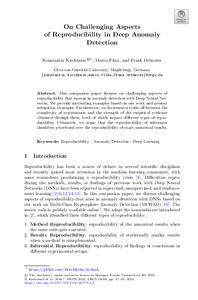
papers/On Challenging Aspects of Reproducibility in Deep Anomaly Detection (13 Jul. 2022)
Our companion paper, On Challenging Aspects of Reproducibility in Deep Anomaly Detection, has been accepted for presentation at the Fourth Workshop on Reproducible Research in Pattern Recognition (satellite event of ICPR 2022). In it, we discuss aspects of reproducibility for our anomaly detection algorithm MCHAD, as well as anomaly detection with deep neural networks in general. In particular, we discussed the following challenges for reproducibility: Nondeterminism: conducting the same …
Categories: Anomaly Detection · Reproducibility
207 Words, Tagged with: ICPR · Anomaly Detection · Reproducibility
Thumbnail for On Challenging Aspects of Reproducibility in Deep Anomaly Detection
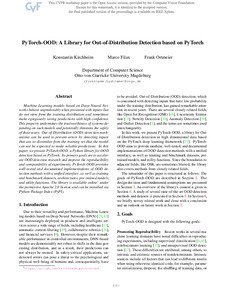
papers/PyTorch-OOD: A library for Out-of-Distribution Detection based on PyTorch (13 Jul. 2022)
Our paper, PyTorch-OOD: A library for Out-of-Distribution Detection based on PyTorch, has been presented at the CVPR 2022 Workshops. You can find the most recent version of the Python source code on GitHub. The library has developed substantially since the original 2022 paper. The current release, documentation, and supported methods are available through the project links below: GitHub · Documentation · PyPI. Abstract § Machine Learning models based on Deep Neural Networks behave unpredictably …
Categories: Anomaly Detection
247 Words, Tagged with: CVPR · Anomaly Detection
Thumbnail for PyTorch-OOD: A library for Out-of-Distribution Detection based on PyTorch